Bakers Delight Smart Shelf Design Prevents Food Waste

The challenge
Each year, the equivalent weight of 456 million loaves of bread is wasted across the Australian bread and bakery value chain. Bread and bakery waste includes grain wasted in primary production, food materials wasted in bakeries, unsold products in retail and uneaten bread and bakery products in Australian homes.
Food waste costs the Australian economy $36.6 billion a year, with significant costs worn by businesses, households, and the environment (FIAL, 2022).
An estimated 104,000 tonnes per year of bakery food materials in retail is either wasted or diverted to animal feed. A major hotspot in retail is unsold bread. Investigation as part of the Bread and Bakery Sector Action Plan found that one of the root causes included oversupply and consumers’ expectations for well-stocked shelves.
Consumer preferences for full shelves contribute to food waste across the industry. In the short shelf-life product industry, shelves are kept full to maximise product sales. This can lead to overproduction, as retailers are motivated to keep their shelves full until the end of the day, so customers can buy products near closing time. Product is therefore made to fill the shelves and then disposed when unsold.
The opportunity
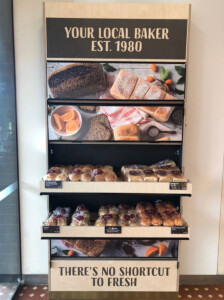
Collapsible shelving unit with top two shelves collapsed and bottom two shelves with product.
Bakers Delight trialled an innovative solution and new smart shelving units to prevent food waste and reduce costs, while appealing to consumer preferences.
Bakers Delight, an Australian-owned multinational bakery franchise chain with more than 700 bakeries in Australia, New Zealand, Canada and the United States, had the idea to introduce the new shelving units in 2020 in the face of COVID-19. Customers were keen to quickly get in and out of shops to minimise their risk of being exposed to the virus.
Bakers Delight introduced shelves in the customer area to allow customers to select their products more quickly rather than waiting for a service person. An important consideration for the design of these shelves was to look full throughout the day, to appeal to consumer preferences, while minimising wastage at closing time.
The solution
The solution involved trialling collapsible shelving units. The shelving units sit adjacent the front counter and hold stock that customers can collect as they enter the shop.
Once the stock is sold and the units start to clear, the shelves can be collapsed. The collapsed shelves display a nice image to maintain aesthetics of fullness and not give the perception of empty shelves to customers. The shelves are modular and can be collapsed gradually as product reduces. This means the shop does not need to bake as much bread to keep their shelves full, reducing overproduction and associated waste.
Each collapsible shelf is estimated to save around 5 tonnes of bread per year, worth an estimated $5000. At the completion of the trial, Bakers Delight had demonstrated the business case for the shelving units. Most units are now installed when a bakery is refurbished as they can more easily be built into the bakery design at this time, increasing sales while not leading to overproduction as a traditional shelf would.
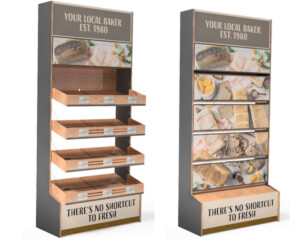
Baker’s Delight’s collapsible shelving unit with shelves open (left) and fully collapsed (right).
This case study was prepared as part of the Bread and Bakery Sector Action Plan to help the sector reduce food waste. The project was initiated by End Food Waste Australia with funding support from NSW Environmental Protection Agency. It was delivered by Rawtec with input from bread and bakery industry partners. For more information visit www.endfoodwaste.com.au/sector-action-plans

Participants