Family-owned Gina’s Table Leading the Way in Transforming Berry Wastage into Nourishing Freeze-Dried Snacks
We spoke with passionate strawberry growers Gina Dang (CEO) and Toan Nguyen (CFO) of SSS Strawberries & Gina’s Table to discuss their recent TRANSFORM project with End Food Waste Australia’s Cooperative Research Centre to develop value-added products that reduced their on-farm food loss and waste.
Who are SSS Strawberries?
SSS Strawberries is an award-winning family business, with seven siblings working together. We are a second-generation strawberry farm and we’ve been here in Bundaberg, Queensland for 18 years. Our business covers about 300 acres of strawberry farm with over 44 million strawberry plants and over 350 employees during the season, making us one of Australia’s’ largest strawberry growers.
Why is reducing food waste important for you and your business?
We grew up in the Outback as refugees coming to Australia, in a family where food was important to us, and we always needed to finish our plates at every meal. Throwing away food and having it not being able to be used is heartbreaking to my mum. When she walks past the pallets full of unmarketable second-grade strawberries outside the shed, she gets pretty heartfelt and teary from the wastage.
Being a larger farm means, the more we grow, the more second-grade, unmarketable fruits go to waste. As the world is also facing food security issues, and the population is growing, farmers will have to find wise ways to grow more products on the same amount of land – because land is getting scarce as well. So, one way to help food security is to do something with these byproducts we can’t sell fresh, and hence this is why we have Gina’s Table. So now we know that a product that would have gone to waste is now going to nourish the next generation.
What was the (specific) food waste challenge you needed to overcome?
Peak season was the worst time for us, as the more fruit we grew, the more waste we would have, resulting in loads and loads of strawberries stuck, waiting to be picked up to be thrown in landfill. What’s even worse is at the end of the season when the market is average, you have perfectly good strawberries still sitting there, out in the field, but you can’t harvest them. Those were the times where we always saying within our families, how can we use these berries?
What opportunity identified itself?
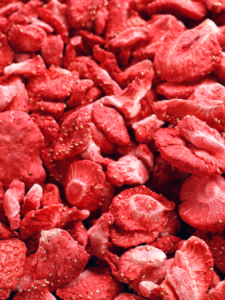
Creating Gina’s Table gives all these second-grade products an opportunity to become something high quality, valuable and nutritious. So underripe, overripe, or even oversized, or undersized fruits that are unable to meet the market standards can be still utilised and eaten, once turned into another value-added product.
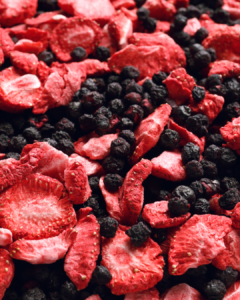
The project helped to expand our existing freeze-dried powder and kombu range for baking, smoothies and deserts, as well as out frozen strawberry range, adding blueberries, raspberries and mixed berries to the range.
We were able to expand this to include chocolate and yoghurt covered products and the consumer testing aspect also helped to improve current products and processing efficiencies. The freedom of exploration when innovating and finding what projects, what products, and what production lines we should have, was an incredibly useful opportunity.
What are the outcomes of this project and the next steps to increase your impact?
Our plan is to further maximise the facility and transform all our waste into these high value products. We are hoping to export these wonderful products internationally, because Australia is still relatively new to freeze dried products. The overseas market is quite bustling, but a lot of the products are not from Australia, they’re all from other countries, so we want to bring our Australian product to their market.
Our plan is to expand to multiple factories around Australia, because Bundaberg is just one farming region. There’s a lot of farming regions around Australia that are also experiencing the same problems, as well as the hurdle of logistic transportation to carry unmarketable fruit from one region to the next, which is quite expensive. What we’re implementing here has the capacity to cater for our region, help other farmers locally and in other regions, and have a greater impact on industry and consumers. So far, we have reduced the amount or produce going to landfill by 80%.
Gina’s Table has now already collaborated with many other food producers and manufacturers within the region. There have been opportunities for connection and collaboration, working in developing not just one production line, but many production lines. We are looking at not just transforming strawberries, but at other opportunities to help growers working with berries, mangos, and apples with their unmarketable fruits as well.
Our mission at Gina’s table is to create a need where every meal is sustainable, every farmer stands tall, with every plate telling a story of hope – that’s what we like to achieve.
How has addressing this benefited you?
This project has particularly helped us with staff employment and expanding our business opportunities. We found that before when we were just farming, we would employ staff more seasonally, but now after the strawberry season, our staff can continue to stay and work with us in the factory for 12 months of the year, which has greatly increased our staff retention.
We were also able to expand our contact circle with our food manufacturing facility, to scope if we can form collaborations to create something with this unique product that we have. So far, we have developed a range of apple products, including freeze dried apples coated or dusted with delicious strawberry powder or mango, which are now being sold in the US on Amazon.
So far, we have been able to Transform over 252,000 kg of waste into value-added products about – 150,000kg strawberries, 50,000kg blueberries, 30,000kg raspberries, 15,000kg apples, 7,000kg of mango, and a number of other types of produce diverted from landfill.
For other businesses looking to get started or expand their food waste reduction initiatives, what have you learnt and what advice would you share?
At Gina’s Table and SSS Strawberries, reducing food waste isn’t just an initiative—it’s a responsibility. Our journey has shown us that true sustainability comes from innovation, collaboration, and a deep respect for the food we grow and the future of legacy we leave behind for the next generations.
For businesses looking to start or expand their food waste reduction efforts, my biggest advice is to think beyond waste, see it as an opportunity. We transformed our excess strawberries into a range of freeze-dried products, extending their shelf life and creating new revenue streams while staying true to our mission of reducing waste. The key is to be creative and resourceful, sometimes, what seems like a challenge can become our greatest innovation.
Collaboration is also essential. Work with like-minded partners, researchers, and food rescue organisations like End Food Waste Australia CRC and QDPI to maximize our impact. Whether it’s repurposing surplus produce, investing in technology, or developing circular economy solutions, working together amplifies results.
Finally, measure progress. What gets measured, gets improved and we continuously use this data to refine our approach. Sustainability isn’t a one-time project; it’s an ongoing commitment.
If you’re serious about making a difference, take that first step. Small changes lead to big impacts and together, we can transform the future of food.
What do your products taste like and where can they be purchased from?
Our freeze-dried products are light, airy and crunchy. You have the old textures and the structures of the fresh fruits, but instead it’s like a candy crunch that melts in your mouth.
Our products are super popular with kids. My kids have it in their lunch box almost every day and they always come back and say “Mummy, you have to put more packs in my lunch box, because my friends want to eat them!”.
20 tonnes of fresh produce donated in less than 12 months – Simon George & Sons share recipe for ramping up food donation
Simon George & Sons and FareShare partnered through the Australian Food Pact to divert an incredible twenty tonnes of premium fresh produce, creating more than 50,000 high-quality, nutritious meals for people facing hardship in Australia, within the first twelve months of partnership.
When purpose meets profit: Radish Events’ mission to reduce food waste
Addressing food waste in the hospitality sector is both a challenge and an opportunity; explore how Radish Events’ commitment to reducing food waste has both environmental and financial benefits, and how they are making an impact – one fish head croquette at a time.
If you are having trouble seeing this form click here.
Taking Action Form
If you're ready to take action on food waste in your organisation please get in touch.
If you are having trouble seeing this form click here.
PACT Portal
...
We use cookies to ensure that we give you the best experience on our website. If you continue to use this site we will assume that you are happy with it.