New ISO Standards to reduce food loss and waste
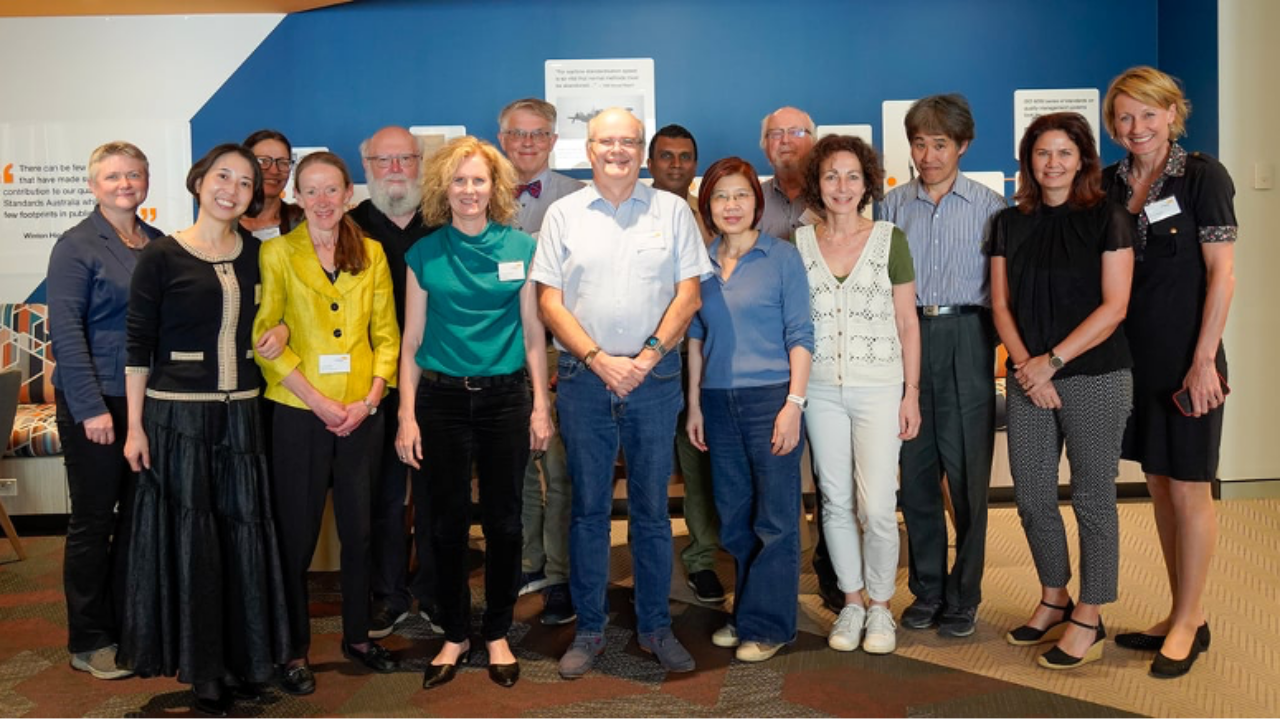
Image Caption: National experts attending the ISO Food Loss and Waste meetings. Mark Barthel*: Front row, 4th from Left to Right
Last month, Standards Australia hosted the ISO technical committee for Food Loss and Waste (ISO/TC 34/SC 20) at their offices in Sydney. Committee members representing 25 countries met for the fifth time to develop new international standards aimed at tackling the global challenge of food loss and waste.
The key objective of the meeting was to advance work to develop three new International Standards to help agricultural food (agrifood) businesses, governments, and others to reduce the vast amount of food that is lost or wasted from paddock to plate.
How will these standards help?
ISO/TC 34/SC 20 Working Group 1 is developing a new certifiable management systems standard, ISO 20001, which provides a management framework to help the global agrifood industry manage, prevent, minimise, and reduce food loss and waste. ISO 20001 is being developed so that it can be used hand-in-hand with other management systems standards, like ISO 22000 (Food Safety Management), ISO 9001 (Quality Management), and ISO 14001 (Environmental Management) – existing standards used widely in the agrifood industry.
Working Group 2 is developing a technical specification that aims to capture and codify global best practice in the measurement, quantification, monitoring, and reporting of food loss and waste (ISO/TS 20008).
Whilst Working Group 3 is developing a standard that sets out the competency requirements for those auditing ISO 20001 and the audit process to be followed.
Technical work on all three of these International Standards is scheduled for completion by the end of 2026, with publication anticipated in early 2027.
Mark Barthel, former Chief Strategy & Policy Officer at End Food Waste Australia and Australian Head of Delegation to the meetings said:
“I’d like to thank End Food Waste Australia for their support in attending these meetings. We hope this suite of standards will support all of the organisations involved in the food supply chain to reduce the amount of food that is lost or wasted in Australia, as we strive to achieve Australia’s target to halve food loss and waste by 2030.”