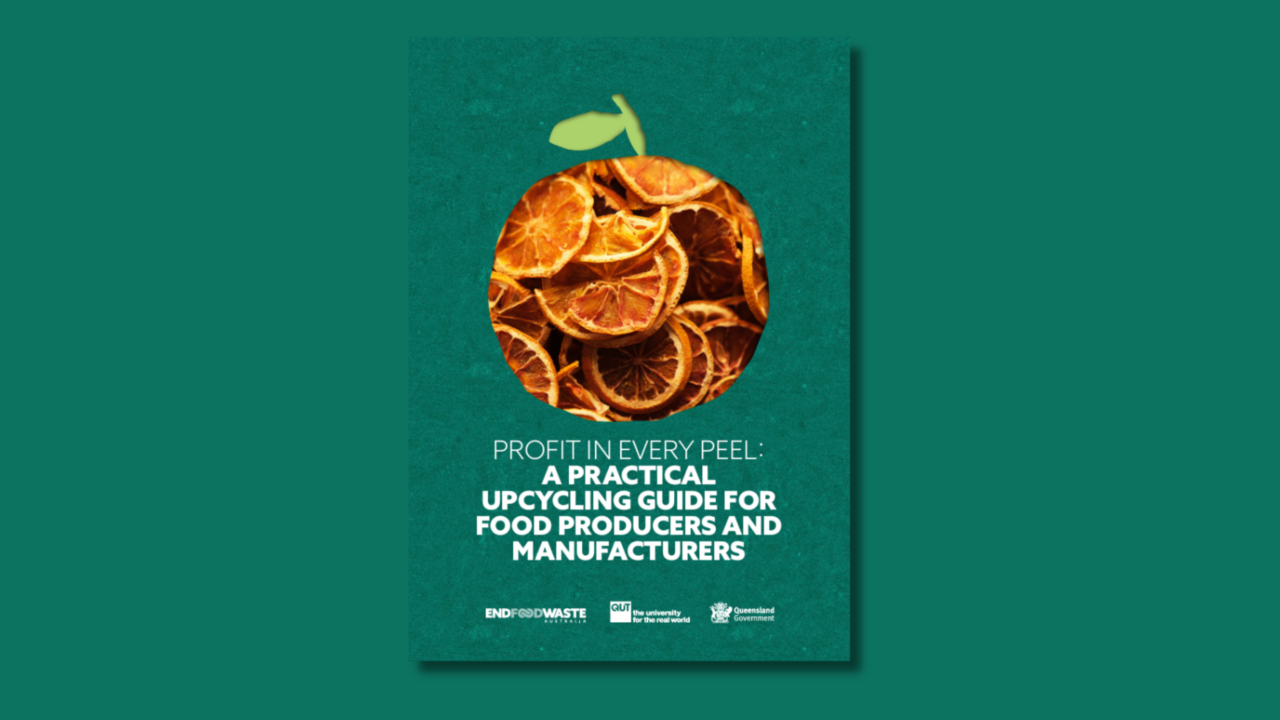
PROFIT IN EVERY PEEL: A PRACTICAL UPCYCLING GUIDE FOR FOOD PRODUCERS AND MANUFACTURERS
ACCELERATING FOOD TRANSFORMATION IN AUSTRALIA
Upcycling presents a major opportunity to transform food waste into revenue. This guide provides evidence-based insights that will help you to start or improve your upcycling, turning surplus, excess or byproduct produce into new, high-value foods.
Why upcycle?
Tap into a significant underutilised resource:
- Australia wastes ~2.96M TONNES 20% of crops of food in primary production and manufacturing each year (FIAL, 2021) and on average 20% of crops never leave the farm (ABARES, 2025).
- Create new revenue streams from existing supply chains.
- Reduce waste disposal costs.
- Support sustainability commitments and goals.
- Join a global market predicted to reach $79.51B by 2034 (Fortune Business Insights, 2026).
Key insights for industry
- Know your market first
Your product is more likely to succeed if you design it for an audience you know will buy it, not the audience you hope to convert. Understanding who will buy your product – and why – is essential, so do your market research and test your product on consumers before scaling up. - Understand consumer preferences for upcycled foods
Consumers show positive purchase intentions for upcycled food on average, particularly for products made from surplus crops rather than inedible by-products or items nearing date labels. Research also tells us that consumers prefer plant-based inputs, resulting in upcycled foods they are already familiar with, like breakfast foods, snacks, baked goods, pastas, sauces, and soups. Consumers are highly price sensitive when foods are labelled ‘upcycled’, but this can be managed by focusing on value, quality, taste, and safety messaging in your marketing over environmental claims. - It doesn’t have to be high-tech
Australian case studies show successful ‘upcyclers’ commonly use simple technologies like dehydrators, mills, and blenders. These low-tech methods reduce upfront costs, allow for gradual scaling, and can accommodate diverse and seasonal inputs. - Leverage your networks and third-party facilitators
Upcycling works best when manufacturers collaborate across the supply chain, rather than working in isolation. Food manufacturing experience is a major advantage, but don’t let this put you off. Where possible, collaborate with supply partners and leverage their respective strengths and resources. Consider how you can use your existing networks or third parties to help explore potential options for utilising food surpluses, identify sources to ensure a consistent or large volume of supply, or find partners with the right equipment or technical expertise. You could also try to build multiple supply partnerships to diversify, reduce risk, and explore shared processing arrangements for cost efficiency. - Use inputs with reliable availability
Supply fluctuation is a major challenge for the industry. Ideally, a reliable supply of your input is going to make things easier. Before committing to a product, assess things like input availability throughout the year and dependency risks if supply changes (e.g., price rise, low supply). - Be smart in your product design
For seasonal inputs, consider using shelf-life extension techniques like drying or powdering to stabilise the supply for use year-round. If you can’t guarantee consistent supply or specific quantities of an input, look at manufacturing products that can tolerate variabilities – in terms of the quality, colour, and/or flavour of inputs. This might mean having seasonal variants or multiple product lines to spread your risk. - Avoid overemphasising “upcycled” branding or environmental claims
Research shows less than a third of Australians know the term “upcycled food” and many misunderstand what it means, associate it with lower quality, or expect upcycled food to cost less, even though production of upcycled food can cost more. Instead, highlight product taste, quality, and nutritional elements. Consumers are also more interested in what upcycling is and the processes used to manufacture the product, rather than broad environmental claims. If you do include sustainability messaging, be aware that environmental claims must be specific to avoid misleading impressions according to the Australian Competition and Consumer Commission (ACCC). - Be cautious with health claims
Some upcycled products may overlap with “functional food” territory if they claim health benefits beyond normal nutrition. This means that the therapeutic goods regulation may apply. Use the Therapeutic Goods Administration’s Food–Medicine Interface Tool to check what regulation applies. Importantly, avoid overstated or unverified health claims. - Ensure compliance with food regulation
Upcycled foods must meet the same standards as all Australian foods, so maintain strict standards in ingredient handling, processing, and storage. Getting the ingredient labelling right is important, so double check it is accurate to avoid costly mistakes. Remember, if you’re upcycling an input/ingredient that has already been processed, make sure all ingredients in the original processed product are listed. It would be good to plan ahead for long ingredient lists if you are upcycling products that were previously processed (e.g., bread, baked goods). - Tap into funding and support structures
Leverage grants, funding, research institutions, and government programs that can provide support in early stages. Funding can support developing a proof-of-concept, pilot manufacturing at a smaller scale, upgrading equipment, improving your business capabilities, or developing the required technology. - Develop a clear business case, not just an environmental pitch
Many upcycled businesses are motivated by sustainability and waste reduction, but investors, retailers, and supermarkets need a stronger commercial justification. Build evidence with things like cost efficiency, market demand, shelf readiness, and waste reduction impact. A compelling business case can unlock funding and will support industry confidence in your product. - Share success stories across the sector
Knowledge sharing will help build the upcycled food industry. Sharing insights around what worked, what didn’t, low-tech solutions, and supply chain models will be particularly beneficial to those starting on the upcycled food journey
References
1. FIAL. (2021). National Food Waste Strategy Feasibility Study—Final Report. https://www.fial.com.au/sharing-knowledge/food-waste
2. ABARES. (2025). Crop loss/waste on Australian horticulture farms, 2023–24. https://www.agriculture.gov.au/abares/research-topics/ surveys/horticulture-crop-loss-23-24#results
3. Fortune Business Insights (2026). Upcycled Food Products Market. https://www.fortunebusinessinsights.com/upcycled-food-productsmarket-113710
Want to learn more about upcycling food?
This guide draws on findings from a study on accelerating food transformation and is part of a series of free resources that includes case studies from growers and manufacturers from across Australia. Explore the research and access the resources today.

Information
The Accelerating Food Transformation project was proudly funded by the Queensland Government and End Food Waste Cooperative Research Centre, whose activities are funded by the Australian Government’s Cooperative Research Centre Program. This work was also supported by Queensland University of Technology.

Timeline
01/04/20023 – 31/10/2025

Author
Hope Johnson, Queensland University of Technology

Participants

