Metcash redistributes
surplus to purpose
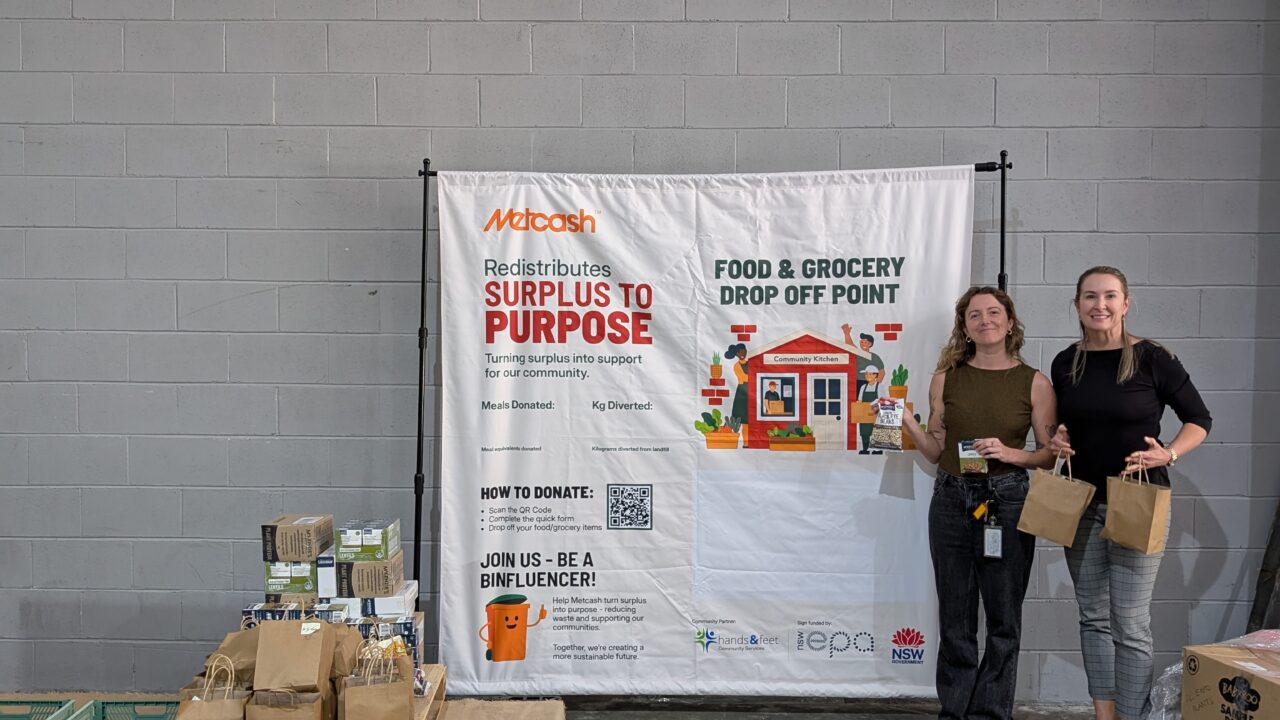
A new staff-led initiative at Metcash National Office is capturing small surpluses that do not fit established food donation channels and redistributing them for community impact. In the first four months, this small but mighty initiative diverted nearly 1,000 kg to a local charity providing free pantry items and meals for community members doing it tough.
A company culture that supports innovation and initiative has enabled the drive and commitment of Metcash food waste champions – Victoria Brooker, Bridget Corcoran and Jane Rodway – to save a literal tonne of food. The initiative shows that staff on the ground often hold the insights for food-saving opportunities, and that food waste action does not need to be large in scale to create meaningful community impact.
Download a PDF of this case study here.
About.
Food moves constantly through the Metcash National Office, as you would expect for a business that supports more than 1,600 independently owned supermarkets, including those operating under the IGA and Foodland banners, and markets an extensive range of private label products, including Black and Gold.
At the National Office, there is a steady stream of food products for tasting and assessment, quality testing, sampling events and marketing activities – resulting in small surpluses with no clear destination.
The challenge.
Not all surpluses can be avoided, and not all surpluses fit neatly into large-scale food donation channels.
Metcash has a strong and long-standing national food donation partnership with Foodbank and Food for Change. This partnership is optimised for store-based donation and delivered the equivalent of 2.5 million meals last year alone.
However, the food the Metcash team had identified at head office was different. It often did not meet the volume thresholds or donation requirements of the broader food donation program, yet it was still edible, high-quality food. Minimum representative supplier quantities for product testing, pre-launch approvals and samples left over from events were some of the drivers of surplus at head office.
This surplus food was often mixed in type, irregular in timing and smaller in quantity. The team believed this food was too valuable to waste, but too complex for the existing system – so they designed a new approach.
The solution.
The Metcash redistributes Surplus to Purpose initiative was created to capture smaller, irregular surpluses and redirect them to a local organisation with greater flexibility.
Food Technologist, Victoria Brooker, saw an opportunity for change, and spearheaded the initiative with the support of Jane Rodway, Sustainability and Brand Standards Project Manager, and Bridget Corcoran, Metcash’s Corporate Waste Lead.
Bridget helped connect the team with Hands and Feet, a local NGO that runs food pantries and distributes prepared meals across Sydney. Hands and Feet agreed to fortnightly collections of surplus food and pantry items. In the early months, Victoria worked closely with the team to understand what donations would be most useful and to translate this into clear operational and food-safe directions for Metcash staff.
“Victoria has championed this initiative from the ground up,” Jane Rodway shared. “This is not part of her formal job description or KPIs – it is something she cares about and fostering that kind of commitment and care is part of our company culture.”
“It has been a real team effort ,” says Victoria, “We are passionate about sustainability and CSR, and we get each other excited about the potential.”
To activate the initiative internally, the team:
- Built internal support by connecting like-minded colleagues.
- Engaged Executive General Managers and their EAs to present the opportunity to business leaders.
- Secured leadership buy-in by presenting clear solutions.
- De-risked the process by designing it to be simple, food safe and compliant.
- Introduced a QR code system so staff can log donations quickly through a short questionnaire.
- Invested a small budget in signage and awareness materials.
- Shared regular staff emails with amounts donated.
- Demonstrated human impact through storytelling, including video content from the charity.
“Knowing that this great food is making it to people who need it most is really rewarding,’
-Victoria Brooker, Food Technologist, Metcash.
Key learnings.
Like many grassroots initiatives, the program faced practical hurdles. Participation sits above and beyond formal job descriptions; it requires staff to adopt a new process, and its success depends on ongoing engagement and communication to maintain momentum.
Make buy-in value clear
By showing how the initiative reduced event waste and solved operational pain points, the team has started to broaden ownership beyond sustainability and product development teams. The program was designed to minimise extra work and positioned as a smarter way of working.
Make it simple to participate
A key to the program’s success has been simplicity. Staff donating surplus food scan a QR code and complete a short form. Clear processes reduce risk and remove friction.
Make impact visible
To help build awareness and grow staff’s participation in the initiative the team arranged a short video from Hands and Feet, showing people receiving the food to connect staff with the real-life impact. A small investment in signage and regular email updates helped build internal visibility and share donation quantities translated into meal equivalents.
Mark it a two-way conversation
Conversations with the local charity helped the team understand the scope of what could be donated and what was valuable to Hands and Feet, which was used to develop the donation guidelines. Local charities often have broader or more flexible donation processes, and can be a great way to build or complement larger donation programs.
“It is a day-to-day way to raise awareness about food waste. We’re passionate about building a waste-conscious culture, and the more people across the business who have food waste on their radar the more impact we can have through our roles, our initiatives, and even our choices at home,”
-Jane Rodway, Sustainability and Brand Standards Project Manager, Metcash.
The impact.
In its first four months, the Metcash redistributes Surplus to Purpose program saved nearly 1,000 kilograms of food.
Donations included frozen pies and nuggets, shredded cheese, canned beans and vegetables, bacon, pet products and toilet paper – many originating from product testing, supplier events or surplus minimum deliveries.
One December donation of surplus bacon became part of a Vinnies Christmas cook-up, with bacon and egg sandwiches handed out to people experiencing homelessness across Sydney on Christmas morning. A simple but meaningful meal was made possible by food that otherwise would have been wasted.
In addition to the food saved, the program contributes to helping build broader awareness of food waste across teams beyond sustainability.
Next steps.
Victoria, Bridget and Jane see Metcash’s Surplus to Purpose as just the beginning. They are planning stronger internal communications aligned with the company waste program, deeper engagement with Hands and Feet (including having the NGO present to staff during lunch & learn sessions and volunteering sessions) and continuing to embed waste avoidance and surplus donation into standard ways of working and waste KPIs. “There’s so much potential,” they agreed.

Information
The Australian Food Pact is led by End Food Waste Australia, supported by WRAP, and funded by Rainier Climate Group.

Participants